Search This Blog

Showing posts with label Sierra. Show all posts

Tuesday, August 22, 2023

Conquests of the Longbow

 Compared to that of their biggest competitor, LucasFilm/LucasArts, Sierra Entertainment's output of graphic adventure games during the 80's and 90's has always struck me as being all over the map in terms of quality. Now, I'm not saying that every LucasArts game is superior to every game made by Sierra. I would definitely take a Gabriel Knight or  Quest for Glory over say, Zak McKracken and the Alien Mindbenders (coincidentally the one game from LucasArts that most closely resembles a Sierra title) any day of the week. However, I do maintain that the weaker titles from LucasArts are still on par with an average game from Sierra.

Which brings us to the subject of this review. A game which is not (and I must emphasize) one of Sierra's average games:  1991's Conquests of the Longbow.

This was the second Sierra game that had Christy Marx, remembered mostly today as the creator of Jem and the Holograms, as the lead designer and writer. The First being Conquests of Camelot: The Search for the Grail, released only the year before. 

Both games has the player take on the role of a famous character from English legend. In Conquests of the Camelot it was King Arthur and since Conquests of the Longbow's secondary title is The Legend of Robin Hood, no points for guessing who you're supposed to be in this game. 

I played Conquests of Camelot for the first time fairly recently. I enjoyed it, but if I have to pick which Conquests game I consider to be the superior, I'd pick Longbow in a heartbeat. It improves on its predecessor in pretty much every way. 

To give you an example; my least favorite parts of Camelot were the occasional arcade-sequences, such as when you had to joust against the Black Knight. Conquests of the Longbow does not disperse with these moments, but it does allow the player to bypass them. This does come at the expense of your overall final score (since you won't receive the points you would have gotten if you had conquered these obstacles), but it's nonetheless a welcome feature. 

Another huge point in Conquests of the Longbow's favor is that it plays fair. Sure, I died a few times, but the deaths always felt (for lack of a better term) reasonable. Which is more than I can say for any King's Quest game I've played.

Story-wise, the plot of Conquests of the Longbow should be familiar to anyone with even a passing knowledge of the Robin Hood myth and includes everything one would expect from a story about the Prince of Thieves and his merry men. In case you're wondering; Yes, there is an archery contest and yes, you have to disguise yourself in order to participate in it.

The Player's main objective is to raise part of an outrageous ransom needed to free King Richard, who is being held hostage by Leopold of Austria (the rest of the money is provided by Queen Eleanor, Richard's mother). Of course, Prince John, who rules in Richard's place, would rather that his brother not return at all, while the money is used instead to enrich himself and his lackeys. 

The Game's characterization is overall solid (with the villains being the weakest link). Robin and his merry men are all well-portrayed with distinct personalities and the game does a good job making the bond between them feel genuine. 

Perhaps the most interesting character in the game though, is Marian. Depicted here not only as Robin's noblewoman love-interest, but as an agent of Eleanor's (acting as a go-between between the unseen Queen and the outlaws of Sherwood Forest) as well as a Druidic priestess and while you do end up having to rescue her from the Sheriff at the end, for the most part, this Marian comes across as strong-willed and accomplished. Exactly the kind of woman you'd believe Robin Hood would fall in love with.

Conquests of the Longbow also contains multiple endings. At the end of the game, you're put on trial and depending on your actions, you might find yourself either handsomely rewarded, or swinging from a rope. 

So far, I've been singing this game's praises, was there any part of it I didn't like? Actually, yes. At one point in the game, you have to capture a pixie by throwing a net in front of him, something that quickly became an exercise in frustration. Earlier in the game, you are required to play Nine Men's Morris (an actual medieval board game) against an old soldier, so that you can win a magical jewel from him and while not as annoying as the pixie-catching, the time I spent on it, made me breathe a sign of relief when I finally beat my opponent and could progress with the actual game.

Oh, and if you've played this game and were able to memorize the Druidic sign-language without consulting the manual, than my hat's off to you.

These are minor complaints though. As a whole, Conquests of the Longbow: The Legend of Robin Hood, is a terrific adventure game, one of the best to come out of Sierra's stable. Highly recommended.

Friday, January 12, 2018

Thimbleweed Park


If you, like me, love adventure games, than Ron Gilbert is a name that you no doubt recognize and hold in high esteem and for those of you who have never heard of this Ron Gilbert fellow before, well, pull up a chair, its time for a brief history lesson: 
Ron Gilbert was instrumental in the development of the point & click adventure game genre. Not only did he create SCUMM, the engine used in pretty much every LucasArts adventure game during the company's golden age, but he also created such classics as Maniac Mansion and The Secret of Monkey Island


Gilbert's (and by extension, LucasArts') design-philosophy stood in sharp contrast to that of Sierra Entertainment, who up until then, had dominated the genre: Gilbert felt that the many deaths presents in games such as the King's Quest series, as well as not allowing players to go back and pick up items that they had no way of knowing would become important later on, thus rendering the player irrevocably stuck, to be deeply unfair and this is reflected in the games he made. Admittedly, the player could die in the early LucasArts adventure games, but nowhere near as much or as often as in those made by Sierra (there's a reason why its called Sierra Sudden Death Syndrome after all).

In 1992, Ron Gilbert left LucasArts to focus on other ventures. He co-founded Humongous Entertainment, which specialized in edutainment titles such as the Putt Putt and Freddy Fish series. He was also the producer of the real-time strategy game Total Annihilation. Now, I should point out that I have not played any of Gilbert's post-LucasArts games and at any rate, they are not what this post is all about. No, this is about Thimbleweed Park, Ron Gilbert's grand return to making a bona fide point & click adventure game of the old-school. In many ways, Thimbleweed Park feels like the closing of a circle, as Gilbert returns to the genre that he helped perfect.
Co-created with Gary Winnick, another old LucasArts employee and close collaborator of Gilbert's, Thimbleweed Park was funded via Kickstarter and was released last year. 

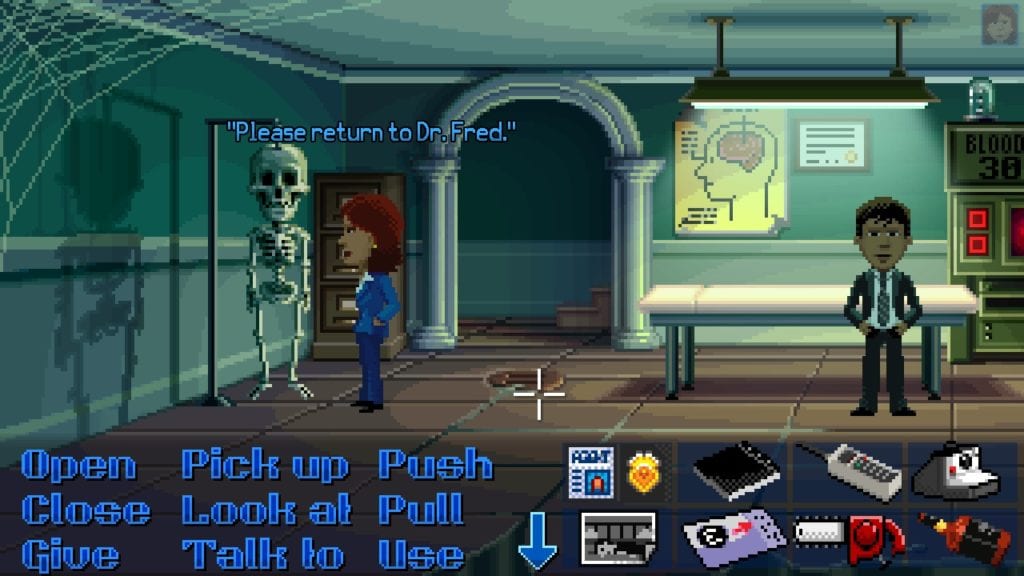
The game takes place in the eponymous town in the year 1987 and features five different protagonists. They are as follows:

Angela Ray and Antonio Reyes - Two FBI agents who have arrived in town to investigate a murder. Or at least, that's the official reason why they are here. Unofficially, they also have more personal motives for being in Thimblweed Park.

Delores Edmund -Niece of Chuck Edmund, owner of the local Pillow Factory and the man who put Thimbleweed Park on the map. Delores was once Chuck's presumed heir, but fell out of favor after pursuing a career as a game designer. With her uncle's recent demise, she has returned to town to hear the reading of his will.

Franklin Edmund - Delores' father and Chuck's put-upon brother. Early on, Franklin is murdered and spends the rest of the game as a ghost. His goal is to escape the confines of the hotel in which he was killed and take farewell of his daughter, before passing on to the afterlife.

Ransome the Insult Clown - Once a popular comedian and the star-act of the local circus. During one of his performances, Ransome insulted the wrong person and was cursed with never being able to remove his make-up. As a result of this, Ransome's career tanked and he is now a bitter has-been, despised by the townspeople.


During the course of the game, the player has to switch between these five characters in order to solve puzzles and come closer to solve the mystery that haunts Thimbleweed Park, a mystery whose solution might lie inside the abandoned Pillow Factory...

If you've played any of LucasArts adventure game, then you'll be right at home playing Thimbelweed Park. The game plays exactly the same as, say Day of the Tentacle or Monkey Island. Basically, you have a list of verbs, such as "use", that you click on and then click on whatever item you wish to interact with. Simple and efficient.

Visually, Thimbleweed Park looks great, with its 2-d graphics being very detailed and lovely to look at. The game also has a really nice atmosphere, mixing the lighthearted and quirky with something more menacing. In that regard, the game definitely reminded me of the first two Monkey Island games, which managed to evoke a similar mood.

The voice acting of the game is uniformly of good, though special mention must go to Nicole Oliver and Ian James Corlett, who do the voices of Agent Ray and Ransome respectively. Oliver is perfect as Ray, a cynical opportunist who usually does not even bother to hide her utter contempt for Thimbleweed Park and its quirky inhabitants, while Corlett makes Ransome in turns deliberately obnoxious, repugnant and, most importantly, funny. 

So, having lavished a lot of praise on Thimbleweed Park do I have everything negative to say about this game at all? Surely, there must be something, right? Well, there is one thing actually and that's the ending of the game. While the characters' individual stories are each wrapped up in a satisfying manner, the big plot-twist, regarding the truth of the town did not really do it for me. I get the feeling that Ron Gilbert wanted to pull another Monkey Island 2; a game whose ending is one of the most famous in adventure game history. However, it didn't work as well the second time around. Unfortunately, I can't go into further details regarding how I felt about the game's ending without giving away major spoilers and I do not wish to do that, since it would perhaps risk turning people off from trying the game at all.
And that would be a shame, because no matter how it ends, the rest of Thimbleweed Park is a terrific game, one that every fan of the genre should have in their collection. I hope its not the case, but if this turns out to be the last adventure game Ron Gilbert and Gary Winnick ever make, its a high note to go out on.

Monday, October 12, 2015

Favorite Adventure Games

Ever since a cousin of mine introduced me to Day of the Tentacle, back when I was a child, the graphic adventure (or point & click adventure, as it has also been called), has been my favorite type of game, rivaled only by the RPG. As such, I thought it high-time that I paid some tribute to this genre, by showcasing what I consider to be some of the best games it has to offer. Are you ready? Well, than, let's jump right in.


Day of the Tentacle (LucasArts, 1993)


Seeing as how this was the first graphic adventure I played from start to finish, its only fitting that Day of the Tentacle kicks off this list. However, its not just sentimentality that makes this game earn a place on it. While Day of the Tentacle may no longer be my favorite game (or even favorite adventure-game, for that matter), I can not argue with any list who puts it in the top-spot. Day of the Tentacle is one of those games that does pretty much everything right; everything from the cartoony graphics, to the puzzles, to the humor of the game are terrific. Created by LucasArts. the uncrowned king of the genre at the height of its power, Day of the Tentacle is, in many ways, what all adventure games should strive to be.

Monkey Island 2: LeChuck's Revenge (LucasArts, 1991)


No list of great adventure-games is truly complete without at least one Monkey Island title on it and while everyone has their own favorite game in this series; LucasArts' flagship title, which focused on the adventures and misadventures of Guybrush Threepwood ("Mighty pirate!"), I'd have to go with the second one. LeChuck's Revenge is everything a worthy sequel should be, being bigger and better than its predecessor, with more locations to visit, more puzzles and more characters. The second (and longest) part of the game, where you are free to travel between various islands in order to find all the map-pieces is pure adventure-bliss that anyone interested in the genre should experience at least once. Also, this game features one of the most memorable endings of any game I can think of.

Indiana Jones and the Fate of Atlantis (LucasArts, 1992)


Easily as good as Raiders of the lost Ark and better than any of the subsequent movies, Fate of Atlantis has everything that a fan of everyone's favorite whip-wielding archaeologist/grave-robber could want from an Indiana Jones game. As Indy you have to race to stop the Nazis from exploiting the ancient technology of Atlantis for their own nefarious purposes. There are three different paths you can take in order to reach the lost city; one path puts the focus on traditional puzzle-solving, the second on action and the final one has you collaborating with the game's heroine, Sophia Hapgood (who rivals Marion as the best female character in the franchise). Regardless of which path you choose, Fate of Atlantis is a great game. Seriously, screw Crystal Skull. For me, this game will always be the real Indiana Jones IV.

Grim Fandango (LucasArts, 1998)


The last truly great adventure-game to come out of LucasArts and in many ways the company's magnum opus. Although the new keyboard-controlled interface could take a bit of time to get used to, compared to the old "point & click"-ways, the richness of the plot and the characters more than make for any of that. In fact, Grim Fandango in my opinion, has the best plot of any LucasArts' game and its set in a brilliantly realized world influenced both by Mexican tradition and classic film-noir tropes. If I have any complaints about this game, I guess it would be that the last half of it isn't as interesting as the first one (a flaw it shares with Monkey Island 2, by the way). However, that's small stuff. everyone should experience the after-life with Manny Calavera as their tour-guide, at least once before they shuffle off the mortal coil for real.

Gabriel Knight: Sins of the Fathers (Sierra, 1993)


Back in the genre's heydays, Sierra Entertainment was LucasArts' rival for the much coveted "King of Adventure Games" -title and although the quality of Sierra's products tended to be more inconsistent than those of its rival, when they were good, they were damn good. The finest game to come out of Sierra was Gabriel Knight: Sins of the Fathers, the first in a trilogy by Jane Jensen. Like its sequels, Sins of the Fathers was a mature game in all the right ways, featuring believable characters and a gripping, complex plot that dealt with themes like revenge, guilt and redemption. The two sequels are also good (a rather infamous puzzle in the third game not withstanding), but the first installment is my favorite. Had this been the only game featuring Gabriel and his assistant Grace Nakimura she had made, Jane Jensen would still have earned her place among gaming's great storytellers.

Quest For Glory IV: Shadows of Darkness (Sierra, 1994)


Next to Gabriel Knight, my favorite series to come out from Sierra would be Quest For Glory, an adventure/RPG hybrid created by husband-and-wife team Lori Ann and Corey Cole. The best game in the series, in my opinion, is the fourth one, Shadows of Darkness which takes place in the land of Moldavia, a land which the forces of evil has a strong grip on. There are several reasons why Quest For Glory IV is one of my favorite adventure-games; the plot is the best one in the series, with influences from both Bram Stoker and H.P. Lovecraft, as well as Russian folklore. The characters are memorable, including the antagonist, who is one of the best in all gaming and it features John-Rhys Davies as the narrator, what more could one possibly want?

Tex Murphy: The Pandora Directive (Access, 1996)


Under A Killing Moon, the third game in Access' series about Tex Murphy, the down-on-his luck P.I., who continually gets caught up in cases in which it turns out that the World itself is at stake, was an innovative game in many ways; featuring an immersive 3-d environment. in which the player could hide behind doors, look for clues underneath desk-drawers, among other thing. However, it was also held back by some amateurish acting (Chris Jones would improve in later games) and a pretty cheesy plot, with a villain whose plan was lifted from Moonraker. of all things. Its sequel, The Pandora Directive took everything that was good about Under A Killing Moon and improved upon it. One of the most interesting aspects of the game was the opportunity to lead Tex down various paths, leading to several different endings, some of them happy, others less so.

The Last Express (Smoking Car Productions, 1997)


Jordan Mechner may be most famous for having created the Prince of Persia series, but in my opinion, his finest work is this game. The Last Express puts the player in the role of Robert Cath, a doctor, who finds himself aboard the Orient Express at the dawn of the first World War.
One of the most unique things about The Last Express is the fact that the game takes place in real-time with all the characters you meet having their own schedules. This means that you have to choose carefully what you're going to do next, whether its to meet a character in order to dig out information from them or wait until the character is gone order to go through their stuff, among other choices. The plot of the game is also very strong, being a mystery in true Agatha Christie-fashion, which successfully uses the political upheavals of the time as a back-drop. Oh, and did I mention that the characters all speak in their own native language, with the Russian passengers talking Russian and so on? How often do you see that? Not just in games, but media in general? The Last Express is by far the classiest adventure-game I've played.

The Wolf Among Us (Telltale, 2013)


Last but not least, we have The Wolf Among Us. I've actually written about this game before, so, I recommend reading my old review of it if you want more details. While The Walking Dead: Season 1 was the game that truly put Telltale on the map, this is my favorite out of the ones I've played from them, so far. Here's hoping we get a sequel at some point.

*****

Well, that's it for now.  If you haven't already played any of these games, than I hope I've made you interested in checking at least one of them out. Most of them are available via Good Old Games or Steam, so they're quite easy to get ahold of.
Until next time, dear reader.